Click
to enlarge map
Click
to enlarge map(THE ASSAULT ON HICKORY HILL appears in the Special Forces Association, The Drop, Fall 2014 edition, to read this story and the background, click--->ASSAULT ON HICKORY)
Located on Hill 950 adjacent to the old Khe Sahn Combat Base
Click
to enlarge map
| During the briefing before I assumed command of the defense of Hickory, I was told that when it is "Socked in", the only fire support we could call on would be the 175mm Self Propelled Gun Battery stationed at Camp Carroll, these guns had a 20 mile range. When I plotted the distance from Camp Carroll, I discovered Hickory would be at the outer limits of the field of fire and thought to myself , who the hell would call in 175 at this distance unless it was absolutely the last resort as any attack on Hickory would be in close, I mean Very Close, so any thing being fired from a long distance would not be that effective or precise for the needs of anyone defending such a small spot. Often while on Hickory, I would look to Hill 1015, realizing it gave outstanding direct and indirect fire onto Hill 950 and could not for the life of me figure out who the hell would occupy the lower hill, giving any advantage to the enemy if he were to occupy 1015, little did I know that the Marines had lost 950 for the same reason and later SOG would aso. During my stay, I kept all my mortars directed toward the top of 1015 and conducted random firings on it and over the other side and other areas on 1015. Once Khe Sahn fell to the North Vietnamese in June of 1968, Hickory was a very small dot on the map and deep in enemy held territory and anytime the enemy wanted it, they could take it, there are many times the hill was completely "socked" in by low clouds and there would be no air support and you couldn't see crap, much less hill 1015 where the enemy would surely position themselves to take Hickory. The enemy could lock down the American on Hickory by indirect fire, walk down 1015 and across to Hickory. To me, it was just a bad place to be, a bad, if not impossible hill to defend, but that is the way it was. My tour on Hickory was June thru mid July 1970--SFC Robert L. Noe |
|
|
GENERAL MAP OF THE AREA OF OPERATION |
||
|
|
 Fire
Mission by SFC Robert L. Noe 1969- See
EXCESS RANGE & KENTUCKY WINDAGE SIR!
below Fire
Mission by SFC Robert L. Noe 1969- See
EXCESS RANGE & KENTUCKY WINDAGE SIR!
below |
 Credit
Special Forces at War by Shelby L. Stanton Credit
Special Forces at War by Shelby L. Stanton |
.jpg) Photo by Gen George Gaspard & SOG A Photo History of the Secret Wars by John Plaster |
.jpg) Photo
by US Army & SOG A Photo History of the Secret Wars by John Plaster Photo
by US Army & SOG A Photo History of the Secret Wars by John Plaster |
 A
view of the Combat Base taken from the top of Hill 950. The river valley and
parts of the river can be seen in the middle of the photo. Credit
Khe Sanh
Veterans Website
taken in 1968 by Bob Donoghue and
featured in John Plaster's book SOG A Photo of the
Secret Wars, P 410 A
view of the Combat Base taken from the top of Hill 950. The river valley and
parts of the river can be seen in the middle of the photo. Credit
Khe Sanh
Veterans Website
taken in 1968 by Bob Donoghue and
featured in John Plaster's book SOG A Photo of the
Secret Wars, P 410 |
|
 Featured
2nd from Left is Jon Cavaiani, CMOH, and to his right is Robert Noe,
both of CCN, Hickory's Radio Relay Site, to the far right is Lloyd
Stout of CCS and to the far left is Chris Pearson (Guin), an Iraqi War
Veteran- Photo taken in New Orleans-Feb 2008 Featured
2nd from Left is Jon Cavaiani, CMOH, and to his right is Robert Noe,
both of CCN, Hickory's Radio Relay Site, to the far right is Lloyd
Stout of CCS and to the far left is Chris Pearson (Guin), an Iraqi War
Veteran- Photo taken in New Orleans-Feb 2008 Jack William, Gene William's of CCC brother who served on an A Team in Vietnam at the same time Gene served with SOG is featured 3rd from left with JoN. |
 Top of Hill 950, Hickory Radio relay Site, Khe Sanh, July 1970. SFC Noe with his platoon of Special Commandos awaiting helicopter pickup. The commando standing facing away from the camera was killed the following week at the CCN compound |
|
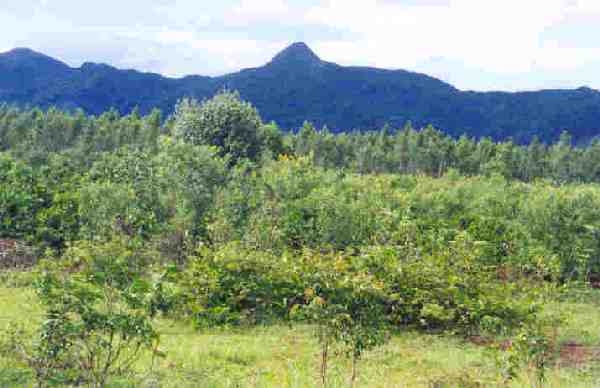
Hills 950 [to the left] and 1015 [center] as they
looked in June of 1998 -- 30 years after Khe Sahn was abandoned. Photo
taken by a Marine Corps vet who returned to Khe Sahn. Note how irregular
and rugged the saddle is between the two hills. Louis
|
 Robert
Noe firing the 50 Cal Machine Gun in the direction of the saddle between
Hill 950 & 1015, Khe Sahn, Republic of Vietnam Robert
Noe firing the 50 Cal Machine Gun in the direction of the saddle between
Hill 950 & 1015, Khe Sahn, Republic of Vietnam |

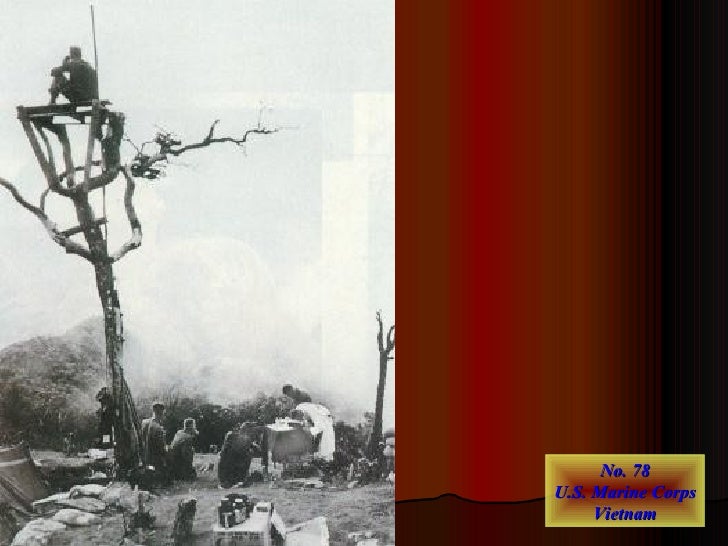
The most poignant of all Hill 950 photographs...
This remarkable photo was taken on July 31, 1967.
The Marines lost 950 to the NVA the previous month -- on June 6, 1967.
The Marines took it back. Note that the MC lost 950 almost exactly
4 years before the US Army would again lose it to the NVA (for the
last time) on June 5, 1971. Louis
|
 Hickory
Apr/May 71 before attack by unknown source Hickory
Apr/May 71 before attack by unknown source |
||
 Photo
by Ralph Morgan after attack on Jul 5th, 1971 Photo
by Ralph Morgan after attack on Jul 5th, 1971 |
Hill 950 or Hickory Hill (formerly named Lemmon Tree) was located north of the abandoned Khe Sanh Combat Base. It was CCN's radio relay outpost atop of hill 950 to monitor and relay radio transmissions from SOG teams operations in Laos. It was the final allied presence in the northwest South Vietnam after the siege of Khe Sanh during the summer of 1968 until it was finally abandoned on June 5, 1971 when it was over-run by enemy forces. Jon Cavaiani was the Security Force Commander that faithful day putting up a fierce counter defense for two days. Jon was captured and spent 1 year and 8 months as a POW and was later presented with the Congressional Medal of Honor
 |
++++++++++++++++++++++++++++++++++++++++++++++++++++++++++++++++++++++++
SFC Manuel Hernandez was the first Plt Sgt I had with CO A, when he DEROS SFC Jim Martin took over the1st Plt SGT slot then he left for MLT 2 Quan Tri to be a Covey Rider. The next Plt Sgt was SFC Richard Hall, I think he was there till I DEROS in NOV 70. Frank "O" left CO A and went to Recon Co sometime in between SFC Martin and SFC Hall. As far as I know we never had any Recon teams walk off Hickory. The only teams that had any walk off were Sugar Loft. LT Lighting Wonderlich and BIG" O "did; but they got struck by Lighting about 300 meters from Sugar Loft. My understanding they also had some incidents on the first mission at Hickory. I hope Jim Martin can give you an update on that. I hope that JIM Martin call provide some Pictures of Hickory from the air when he did fly overs of the site. I will try to get a hold of The Big "O" and get some insight from him about Co A, Hickory, and Sugar Loft. More later on some Bright Lite Missions. Plus my two Recon Missions at the end of my tour.
(NOTE BY NOE: I was on Hickory when Lt Wonderlich and the guys he was leading was hit by lightening, we were monitoring the radio, at first we though they had been ambushed, but after the dust settled, it seems god wanted to light their fire....RLNOE)
EXCESS RANGE & KENTUCKY WINDAGE SIR!
(According to Major "Speedy" George Gaspard, who was the XO of the 1st Bn, 1st SFGA where he assigned me as the XO and later the CO of Detachment A #5. He realted my action as his Special Project NCO, One Zero school and on Hickory lead the CCN Command to award Battlefield Commission. At one of the SFA Reunions. See photo. as a Brigard General, Retired, he related to me that he kept a close monitoring of my activities after I finished my work for him and the SGM Pillows via monitoring radio traffic of the 1-0 school where the team made enemy contact and the radio traffic on Hickory where a recon team was ambushed and my conducting the fire mission with the Mortar. He recalled I rescued a Vietnamese from drowning months earlier at CCN). NOTE: CCN awarded me with a Bronze Star for Merit after 3 months working as a Special Project NCO before going to the Recon One Zero Course.. See Order for this below the mission
When I arrived, Hickory had one 4.2 inch Mortar (M2), among the many weapon systems, for camp defense that fired a 107mm High Explosive and White Phosphor rounds with a maximum range of 4,020 meters (approximately 2.5 miles); however, the weapon had no sight as it seems to have been lost long ago and had not been replaced. Although, it was one of the first piece of equipment I requested, it never arrived during my stay.
One day, I believe to be around Mid June 1970, I was in my bunker when the Army Security Agency (ASA) American Radio Operator who kept himself in the Commo Bunker and we rarely seen, appeared excited saying he was receiving an emergency request for fire support on FM frequency. I exited the bunker and turned on my AN/PRC-77 and dialed up the frequency, what I heard was incomprehensible at first as there were sounds of screams and shouting and a hell of a lots of gunfire with at least one machine gun blasting away - someone was caught up in an ambush and being decimated.
After a few moments, a voice shouted over the radio, screaming for help, identifying himself as the Team Leader. He reported his coordinates, which I plotted placing him on Hill 861 along the visible ridge line across the Khe Sahn valley and at a distance beyond 5,000 meters, out of range of any weapon system we had and out of range of any artillery support. The extreme fear could be heard in the screaming and weapons firing when the team leader reported one of his men had just been hit bad, he had several other down. He begged me to help. The ASA Radio Operator reported that Air Support was 10 to 15 minutes out, I immediately relayed this to the Team who informed me that they didn't have 10 to 15 minutes, by that time they would be all dead.
I screamed into the radio microphone handset (being caught up in the tempo of the moment and to ensure he could hear me) keep his head down tight as I was going to do something. I didn't have a weapons that would reach him and the only one that could be "Jerry Rigged" didn't have a damn sight. I did have line of site to his location. I ran to the 4.2 mortar pit dragging the radio being held by my Yard Platoon Leader with the platoon Interpreter in tow. We jumped in, quickly pulled two HE rounds out of the storage bind, opening the canisters, pulling the power bags off one and using black electrical tape, taped them on to the other round. Swinging the mortar around and estimating the elevation, I dropped the "Hot" round down the tube, pulled my bino's out, checked the valley floor out and did not see an explosion. I contacted the Recon Team Leader who said he thought he hear an explosion, but it was on the other side of Hill 861. I readjusted the mortar elevation, repeated the process of doubling up the power bags and dropped it in. After a very few seconds, the radio blared, the report was the round hit close to them with a "bang." There was a difference in the background noise coming out of the radio, the screaming and shooting had stopped for about a minute before resuming. The Team Leader reported shouted the round still had gone over them but much closer. I again adjusted fired another round, which was reported to be close, we could see a puff of black smoke on the ridge line on 861 close to his reported postion, I adjusted left 200 to make sure I was not rignt on the Team then started dropping rounds as fast as I could get the power bags doubled up, hoping and praying I didn't drop one on the good guys. I could see the impacts on the hillside on 861 near the rim and had to make continued adjustments to the mortar as the doubling up the powder bags moved the mortar considerably. After the 2nd or 3rd round, The Team Leader reported they were not receiving any incoming fire from the NVA, the NVA just stopped firing. During this entire period, my Montagnard Platoon Leader and Interpreter stayed with me in the mortar pit doubling up the powder bags constantly telling me "Trung Si, you booko dinky dow (Sp?)" shaking their heads as they worked as fast as they could. The remainder of our Platoon ran to the other side of the hill and sought cover in case our mortar blew up.
What seemed like a life time, but was in reality about 15 minutes after dropping the first round, the ASA Radio Operator reported "fast flyers" coming in and to stop the mortar fire. Within a minute, two Phantoms jet fighters appeared and worked hill 861 over, along the same ridge line some of my round had hit. Our entire platoon emerged from their safety and we sat and watch the jets perform acrobatics in the sky. A short time later a couple of Helo's were observed coming in and the team was recovered.
I never learned who the team was ambushed that day, I suspect it was a US Marine Patrole as the area was in the Marine Area of Operation. The picture in the upper left is me firing the mortar in support of this mission, on the mortar pit floor are the canisters from the many rounds fired.
I have always thought my actions must have confused the NVA. They knew what weapons we had on Hickory and knew the top of Hill 861 was out of our range and they also had to know they were out of Artillery range. I suspect they stopped firing on the Patrol because they could not figure out where the high explosives were coming from.or the rounds were hitting very close to them? However, I am sure they ultimately figured it out. Jon Cavaiani and I (out of humor) tell people that because of my aggressive action against the NVA, it pissed them off and that's why Hickory was later overran. I'm sure this is not the case, it may be part of it, but Hickory was inside their turf, behind enemy lines, and they didn't want it there, plus the fact, its presence allowed our teams in Laos and the DMZ to communicate back to main headquarters, thus an additional treat to the NVA.
Robert L. Noe, SFC, Security, Hickory Radio Relay, CCN 1970\
 Robert Noe, George Gaspard, unk, & Jack Frost roomate in CCN with Robert
Bronze Star for Merit,
CHOP, CHOP
For several nights in a row shortly after two am, there was a chopping sound emulating in the jungle that would continue until about 4am in the NE sector. I and my Yard platoon leader would search the tree line with Bino's during the daylight hours, until he reported there was what appeared to be a new "opening" in the wood line, a darkened area not previously there. We watched this area for the next two days and determined the darken area was growing and it was the location of the nightly chopping sounds. I took the 5.7 mm Recoilless Rifle, bore sighted it, test fired it a couple of times on the opposite side of the hill, until I was sure it would hit what it was aimed at. I relocated the RR to a position where I could sight it in on growing dark space in the tree line. Sight the weapon in on the exact spot, packed it with sand bags, rechecked the alignments/sighting, then put my Yard Platoon leader in charge of two people he trusted to guard the weapon. I was apprehensive, couldn't sleep. Around 2am, the chopping started again, I waited until 3:30am, the chopping continued unabated until I pulled the trigger. The back blast was deafening, there was a flash/explosion at the point where the chopping was. That ended that, the rest of the time our platoon was on Hickory, we never heard of any more chopping. We figured, the NVA were building an observation stand in the tree line to observe us. -- RLNoe
NORTH VIETNAMESE ATTACK ON HICKORY RADIO RELAY, HILL 950, REPUBLIC OF VIETNAM
JOHN ROBERT JONES
05 Jun 71- John Robert Jones, SGT E-5, USASF, TF1AE (CCN), Training Advisory Op, Da Nang, KIA. Jones was performing defense duties of a remote radio relay site "Hickory Hill" ( Hill 950) located deep in enemy held territory at Khe Sanh when attacked by a battalion size enemy force. The site is normally defended by two Americans and about 40 Indigenous soldiers. However, there were 27 Americans and 67 SCU, which includes a squad from L Co, 75th Rangers defending the site this date. Evacuation started but due to adverse weather conditions, the evacuation was halted leaving SGT Jones and Jon Cavaiani, SSG E-6, with about 20 indigenous soldiers who fought on through the night SGT Jones was KIA- and his body not recovered and SSG Cavaiani was captured and untimely released in 1973. SSG Cavainai was awarded the Medal of Honor posthumously for his action as he was originally thought to have been killed in action .ADDED: Reference Hickory Radio Relay Site. In October/November of 1969, when I was Opns Officer at CCN, the Marines pulled off of Hickory without notice. Our radio people had to relocate to Fuller Marine Base. However, our antennas were masked in that location. The next day we airlifted back into Hickory to resume our activities using our own companies/platoons as security. Hickory was in shambles as the Marines had blown up everything. The unfortunate part of this story is that we lost a recon team in Laos because of no radio contact. Each Tuesday I would go to Phu Bai and brief 24th Army Corps about significant activities in our AO. I informed the G2 and the Chief of Staff as usual. The reopening of Hickory called for a special briefing to Gen Mel Zais, Corps Commander. I had been his football coach in the 187th and we met frequently in the Pentagon. His words were " Speedy, I don't know if we can get your guys out if they are overrun." I responded by saying that we were radio blind without Hickory and that we would have to stay." BG “Speedy” George Gaspard (then a Major), CCN

THIS ARTICLE CONTAINS TWO ERRORS:
1. ONE AMERICAN DIED. THE OTHER GOT OFF THE MOUNTAIN TOP ONLY LATER TO BE CAPTURED AND BECAME A POW IN NORTH VIETNAM.
2. THE TOP SECRET RADIO EQUIPMENT WAS DESTORYED BY THE AMERICAN WHO ESCAPED THEN WAS LATER CAPTURED.
credited to Jim Arrowood is the above photograph of the (infamous) UPI article
JOHN CAVAIANI AND HICKORY RADIO RELAY SITE
Jon Cavaiani
Born: August 2, 1948
Royston England
War: Vietnam
Rank: Staff Sergeant, US Army, Vietnam Training Advisory Group
Location of action: Republic of Vietnam
Date of action: June 4 and 5, 1971
Medal received from: President Gerald Ford, December 12, 1974
Official Citation:
Staff Sergeant (S/Sgt.) Cavaiani distinguished himself by conspicuous gallantry
and intrepidity at the risk of life above and beyond the call of duty in action
in the Republic of Vietnam on June 4 and 5, 1971 while serving as a platoon
leader to a security platoon providing security for an isolated radio relay site
located within enemy-held territory. On the morning of June 4, 1971, the entire
camp came under an intense barrage of enemy small arms, automatic weapons,
rocket-propelled grenade and mortar fire from a superior size enemy force.
S/Sgt. Cavaiani acted with complete disregard for his personal safety as he
repeatedly exposed himself to heavy enemy fire in order to move about the camp's
perimeter directing the platoon's fire and rallying the platoon in a desperate
fight for survival. S/Sgt. Cavaiani also returned heavy suppressive fire upon
the assaulting enemy force during this period with a variety of weapons. When
the entire platoon was to be evacuated, S/Sgt. Cavaiani unhesitatingly
volunteered to remain on the ground and direct the helicopters into the landing
zone. S/Sgt. Cavaiani was able to direct the first three helicopters in
evacuating a major portion of the platoon.
Due to intense increase in enemy fire, S/Sgt. Cavaiani was forced to remain at
the camp overnight where he calmly directed the remaining platoon members in
strengthening their defenses. On the morning of June 5, a heavy ground fog
restricted visibility. The superior size enemy force launched a major ground
attack in an attempt to completely annihilate the remaining small force. The
enemy force advanced in two ranks, first firing a heavy volume of small arms
automatic weapons and rocket-propelled grenade fire while the second rank
continuously threw a steady barrage of hand grenades at the beleaguered force.
S/Sgt. Cavaiani returned a heavy barrage of small arms and hand grenade fire on
the assaulting enemy force but was unable to slow them down.
He ordered the remaining platoon members to attempt to escape while he provided
them with cover fire. With one last courageous exertion, S/Sgt. Cavaiani
recovered a machine gun, stood up, completely exposing himself to the heavy
enemy fire directed at him, and began firing the machine gun in a sweeping
motion along the two ranks of advancing enemy soldiers. Through S/Sgt.
Cavaiani's valiant efforts with complete disregard for his safety, the majority
of the remaining platoon members were able to escape. While inflicting severe
losses on the advancing enemy force, S/Sgt. Cavaiani was wounded numerous times.
S/Sgt. Cavaiani's conspicuous gallantry, extraordinary heroism and intrepidity
at the risk of his life, above and beyond the call of duty, were in keeping with
the highest traditions of the military service and reflect great credit upon
himself and the U.S. Army.
-----------------------------------------------------------------------------------------------------
THE QUESTION WAS: WHO SUBMITTED JON FOR THE CMOH? WHO WAS THE CAPTAIN THAT WAS WOUNDED?
Bio:
Jon Cavaiani came to America in 1947 with his parents at the age of four.
Although he was classified 4-F because of an allergy to bee stings, he enlisted
in the Army shortly before being naturalized in 1968. He qualified for Special
Forces and was sent Vietnam in 1970.
As a prisoner-of-war in Vietnam, Cavaiani spent time in Plantation Garden camp
and interrogation center and then at the Hanoi Hilton. He was held prisoner for
twenty-three months, and lost 106 pounds during his incarceration. As the papers
were prepared for awarding him the Medal of Honor, he was originally thought to
be MIA, (missing in action), but his name was heard on a Viet Cong “Liberation
Radio” program regarding a letter from the POWs asking to end the war.
 From
American Valor website From
American Valor website
|
 Jon
showing me his fishing paddle which displays his medals,. Jon
showing me his fishing paddle which displays his medals,. |
 Jon
signing the MACVSOG Medal of Honor Print Jon
signing the MACVSOG Medal of Honor Print |
 Jon
being presented the MOH Print by the University of California in Sacramento,
CA Jon
being presented the MOH Print by the University of California in Sacramento,
CA |
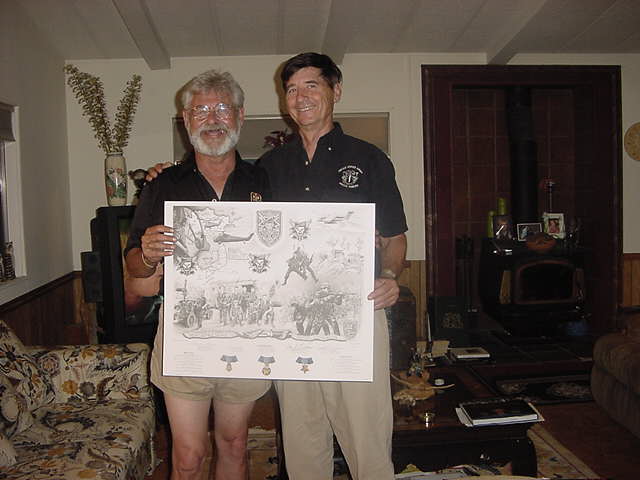 Jon
and Robert Noe posing with the MOH Print in Jon's home. Jon
and Robert Noe posing with the MOH Print in Jon's home. |
 Jon
giving a presentation to the community at the University of California Jon
giving a presentation to the community at the University of California |
 Jon
posing with Army Recruiters in California Jon
posing with Army Recruiters in California |
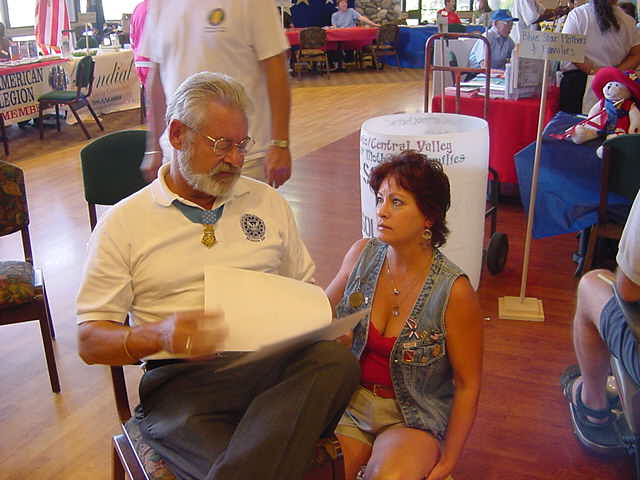 A
female asking Jon to review some material the University. A
female asking Jon to review some material the University. |
|
SGT RALPH MORGAN, THE GUY WITH THE BIG SMILE, WAS ON HILL 950 AND FOUGHT THAT DAY AND WAS AWARDED THE SIVER STAR, HIS CITATION IS BELOW AND EXPLAINS HIS ACTIONS THAT DAY.