RECOVERY OF REMAINS 30 YEARS LATER OF RT PENNSYLVANIA & BIKINI RED THREE
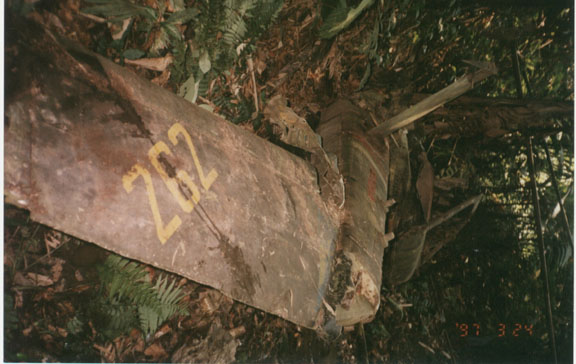
The tail boom of UH-1H 262 (photo taken in 1997)
This story details the recovery of the remains of RT Pennsylvania and Helicopter
Crew of UH-1H 262, 170th AHC, "Bikini Red Three" lost on 24 March 1970. See
Chronological KIA/MIA list for detailed narrative and also see "Into
the Killing Field, Mar 24, 1970" in the Tales from SOG. RT PA men lost: John
Arthur Boronski, SSG, Team's 1-0; Gary Alan Harned, SGT, Team's 1-1; Jerry Lynn
Pool, 1Lt, Team's 1-2. 170th Aircrew Lost: Michael Davis O'Dannel, Cpt, Pilot;
John Charles Hosken, WO1, Co-Pilot; Rudy Morales Becerra, SP/4 & Berman Gande,
Jr., SP/4. Also lost: an Unknow Number of Special Commando Scouts.
Finding the secrets lost down No Name Creek
by Michael Hayes
NO NAME CREEK - The original operation on March 21, 1970 in the remote jungles
of Ratanakiri was top secret. The six-man American Special Forces team,
including Montagnard comrades-in-arms, had been ferried in from Vietnam and
dropped off by helicopter on a reconnaissance mission that didn't exist
"officially". The highly-trained commandos, who carried no US-made equipment and
bore no military insignia, were part of a clandestine US operation obliquely
named the "Studies and Observations Group" or "SOG" for short.
Set up back in 1964 at the request of then-US Secretary of Defense Robert
McNamara, SOG would develop, according to "SOG: The Secret Wars of America's
Commandos in Vietnam", by John Plaster, into "the largest covert military unit
since World War II's OSS".
The Americans were desperate for on-the-ground intelligence as Hanoi was pouring
men and material down through Laos and Cambodia into South Vietnam, along an
elaborate network of jungle tracks. Plaster writes that by 1967 "NVA forces in
Laos and Cambodia had climbed above 100,000 with 40,000 of them detailed as Ho
Chi Minh Trail security; another 100,000 NVA passed down the Trail that year en
route to South Vietnam".
With SOG fielding about 40 Americans at any one time in Laos and Cambodia, it
was their job "to penetrate enemy redoubts to wiretap, ambush, kidnap, mine and
survey the North Vietnamese". The task was a dangerous one. SOG casualties ran
over 50 percent and many of the Green Berets never made it home (See MACVSOG'S
KIA/MIA CHRONOLOGICAL LIST). The team in Ratanakiri spent three in the dense
jungle just a few kilometers from the Lao Border, evading North Vietnamese
trackers and collecting what information they could in an area that was teeming
with NVA troops.
By the time they reached the point where they were to be picked up, they'd taken
two casualties. A Huey UHIH helicopter hovered while the weary men scrambled
aboard. It rose to abut 100 feet and then was hit by a RPG round that blew it
apart, the chopper crashing to the ground in a ball of flames. Seven Americans
were lost.
Fast forward almost three decades. The "Vietnam War" is ancient history for
most, but the Ameicans still want to bring their boys home. Dr. C. E. "Hoss"
Moore stands knee-deep in the muck of the creek he calls "No Name" near the Lao
border, surveying the wreckage of the Huey UH1H. He's one of eight Americans and
an 80-man Cambodian crew that spent four weeks recently looking for remains of
the seven GIs lost back in 1970.
The late-fortyish, barrel-chested Kansan didn't serve in the Vietnam War, having
been exempted by a hearing defect. Hoss now feels like he's "doing his bit" to
help close the final chapter of the war effort.
The nearest Cambodian village is about 30 kms away, perhaps seven days walk on
foot through some of the Kingdom's densest, seemingly pristine jungle, and it's
hard to imagine that war has ever touched this quite land, now designated a
National Park where tigers, wild elephants and sun bears are said to roam
freely.
"Inside the grid, Hoss is King", says US Army Capt Matt Fuhrer of the team's
anthropologist, who decides where and how deep to dig, and who may have to
testify in court years down the road if someone contests the US military's
efforts. On paper the concept is simple: identify a sight where it's believed
there are remains of Americans lost during the war, dig it up and shift through
the dirt.
In reality the work is painstaking and tedious. "Everyone thinks we come out and
dig up femurs", says Fuhrer, reflecting on the fact that the team would be lucky
if they found a few charred bone fragments to take back to a lab in Hawaii for
exhaustive examination.
The effort in Ratanakiri was particularly complicated and involved the
cooperation of the Vietnamese, Cambodians and the Americans. The Americans knew
abut the crash but were unsure of its exact location. An initial tip came from
an 80-year old man who had hunted in the region and remembered seeing the
helicopter wreckage.
In March 1997, a joint Cambodian-Vietnamese team entered the Dragon's Tail from
the Vietnamese border on foot. After a seven-day trek, including four on a
make-shift rafts, the hunter led them directly to the crash site. "One of our
team members was crying", said RCAF Col. Korm Sokhon, who took part in the
mini-expedition and remembered his crew wondering if the old man was leading
them on a wild goose chase.
With the site identified, a landing zone was carved out of the nearby jungle a
year later so that the recovery operation could begin in earnest in mid-January.
The Americans set up shop in Ban Lung, hired the work crews and security forces,
and contracted the services of Lao West Coast Aviation to ferry people by
helicopter to and from the remote dig area. At the end of the day, remains were
discovered, as they were at another recovery operation at an F4 Phantom jet
crash site outside of Ban Lung. However, US officials are reluctant to speculate
on any details of who may or may not be identified. That process may take
several more years back in the states.
As for the political debate surrounding the POW/MIA quest and the money being
spent on the effort, the boys in the field are happy to let others wrestle with
it. Quipped Cap. Fuhrer: "We leave all that to echelons above reality".
The article is from the English language Phnom Penh Post, Volume 7, Number 4,
February 27- March 13, 1998.
Addition Submitted by Clyde Sincere
On 24 March 1970, RT Pennsylvania, MACVSOG OP-35 from CCC consisting of three U.S. and five Indigenous long-range reconnaissance patrol members were being extracted while under heavy enemy contact by a UH-1H helicopter flown by members of the 170th Aviation Company, 17th Aviation Group, lst Aviation Brigade. Immediately following the extraction, aircraft commander Major Michael D. O'Donnell transmitted that he had the entire eight-man team on board and was departing the area. As the aircraft began its ascent, there was an explosion in the aircraft. The helicopter continued for about 300 meters when another explosion caused the aircraft to crash. Aerial search and rescue efforts were initiated, however, there was no sign of life at the crash site.
In January of 1994, a joint search team interviewed Le Thanh Minh of Kontum. Minh reported that in April 1993 while searching for aluminum, he located a crash site in Cambodia. He stated he found human remains, three dog tags, a first aid kit and a rucksack. He also heard that people from Laos had discovered a watch, a gold ring and an AR15. He further indicated that the crash site was spread over a 100 meter area. He stated that the tail section of the aircraft was visible and engraved with the number "262". He gave the dog tags to the team, two were Berman Ganoe, Jr. and one belonged to John C. Hosken, (both crew members of the Huey).
In January of 1998, a joint search team entered the area of the crash site and this time they were successful in locating the aircraft. The remains of all of the crew and team members were recovered, along with dog tags, weapons and other personal effects. After many years, the brave men of Bikini Red Three and RT Pennsylvania were on their way home.
At 1300 hours, 16 August 2001, A group funeral service was conducted at the Old Post Chapel, Fort Myer, Virginia the for fallen soldiers. Interment at Arlington National Cemetery followed the funeral service. There was one casket containing the remains of some of the above honored men. There were some family members who elected to have their loved ones remains interred near their homes of record. For instance, SSG Rudy Beccera's family is having him interred at Greenlawn Cemetery in Rosenberg, Texas with full military honors on Sunday, 19 August 2001 at 1400 hours. Family members of both the aircraft crew and RT Pennsylvania participated in the services with full military honors. Seven National colors were presented to family members in a very somber interment service.
A number of Special Operations and Special Forces Association members were also present to honor these fallen comrades: Michael Ash, SOA # 1432-GL; Robert Bechtoldt, SOA # 146-GL and his son John.; Neil Coady, SOA # 565-GL and his wife Kathy; William Deacy, SOA # 1303-GL; R.J. Graham, SOA # 184-GL and his wife Joan. Also two friends of R.J. came: John and Ryan Long. Wally Johnson, President, Chapter XI, SFA; Robert Jack, SOA # 414-GL; Al Keller, SOA # 1488-GL; William Lueders, SOA # 664-GL; Gene McCarthy, SOA # 256-GL Lloyd O'Daniel, SOA # 1469-GA; Clyde Sincere, SOA # 010-GL; Michael Wilson, SOA # 1338-GA; James L. Young, Pending SOA Membership, his wife Candy and daughter; Elizabeth. Additionally approximately 60-75 family members and guests were in attendance.